 GAMUT
GAMUT Interactive visualization
Layered Bundle Explorer
Choose a collection of notes, then explore the different orders in which they can unfold.
Advanced views and measurements
Loading musical collections…
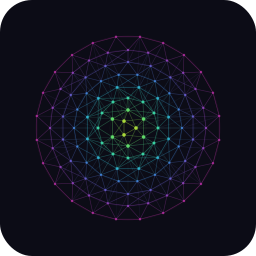
Graph: nodes = pitch-class set classes, color = cardinality, size = preserving transpositions, edges = one-note add/remove. ● = fiber available.
Fiber (dashed circle): vertices = cyclic orderings of the selected set, edges = adjacent-swap distance. Select a vertex or an ordering for detail. Use the ordering selector below for persistent details.
Reading the graph
Each node is a pitch-class set class under transposition/inversion equivalence, identified by its Forte number (e.g. 3-11 for the major/minor triad). In the default coloring, color encodes cardinality (how many notes); size counts preserving transpositions, not all symmetries.
Each edge connects two set classes that differ by adding or removing a single pitch class in the content graph. This is an adjacency rule, not a claim about perceived compositional distance. Click any node to select it; the detail panel shows its Forte number and common name where one exists.
Shell view arranges nodes by cardinality (radius) and similarity (angle). Rosette overlays local order fibers. MDS approximates the chosen distances in a lower-dimensional layout. 4D Projection rotates display coordinates in base/fiber planes. Neither is a certified rendering of the full geometry.
Reading the fiber
Zoom into any node and a dashed circle appears: the order fiber. This is where content meets order.
Each vertex inside the fiber is a distinct rooted cyclic ordering of the selected pitch classes — a way to sequence the same notes into a melody or voice-leading path. For a set of k notes, there are (k−1)! such orderings, regardless of the set's symmetry order.
Each edge connects two orderings that differ by swapping a single pair of adjacent notes. The displayed result is an adjacent-swap graph on selected rooted orderings. Graph paths count such swaps; screen proximity need not represent that graph distance.
Two composers using the same chord produce different music by choosing different orderings. The dataset enumerates fibers through cardinality five and samples at most 96 orderings per larger fiber. It contains 14,262 orderings across 216 fibers, not every possible ordering.
Learnability overlay
The Fiber color control offers two measurements from the same grammar-induction machinery that scores our encoding protocols: self-compressibility (cr) — how much a traversal's early laps teach a grammar that compresses its later laps — and order-dependent lift — the compression advantage of an ordered training prefix over a shuffled-prefix baseline. These algorithmic measurements are not demonstrated human learnability.
Reported for the 14,262 cyclic orderings in this finite dataset: cr correlates with step entropy at Spearman ρ = +0.16, lift at ρ = +0.54, and cr with word length at ρ = +0.55 (a confound probe — read cr within a fiber, at fixed content, rather than across fibers). Constant step words like the whole-tone and diminished cycles sit at lift exactly 0 by construction.
Step entropy measures gap-histogram diversity, not melodic smoothness. The Lean release verifies discrete representation contracts; it does not certify this dataset, its layouts, or perceptual usefulness.