 GAMUT
GAMUT Interactive visualization
Layered Bundle Explorer
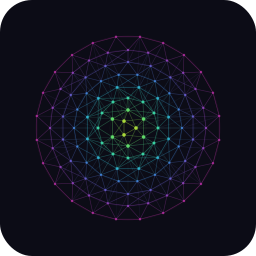
An interactive atlas of the layered musical space. Switch between coordinated views to see how content classes, order fibers, and spectral structure organize the universe of twelve-tone pitch objects.
Layered Bundle Explorer
A layered explorer for shell, rosette, MDS, UMAP, and 4D projection views of the musical bundle.
Graph: nodes = pitch-class set classes, color = cardinality, size = symmetry order, edges = one-note add/remove. ● = fiber available.
Fiber (dashed circle): vertices = cyclic orderings of the selected set, edges = adjacent-swap distance. Hover vertices for detail. Zoom in to reveal.
Reading the graph
Each node is a pitch-class set class under transposition/inversion equivalence, identified by its Forte number (e.g. 3-11 for the major/minor triad). Color encodes cardinality (how many notes); size encodes symmetry order (larger = more self-maps).
Each edge connects two set classes that differ by adding or removing a single pitch class — the minimal compositional step between harmonies. Click any node to select it; the detail panel shows its Forte number and common name where one exists.
Shell view arranges nodes by cardinality (radius) and similarity (angle). Rosette overlays local order fibers. MDS is a metric-faithful embedding. 4D Projection rotates the full bundle in base/fiber planes.
Reading the fiber
Zoom into any node and a dashed circle appears: the order fiber. This is where content meets order.
Each vertex inside the fiber is a distinct rooted cyclic ordering of the selected pitch classes — a way to sequence the same notes into a melody or voice-leading path. For a set of k notes, there are (k−1)! such orderings, regardless of the set's symmetry order.
Each edge connects two orderings that differ by swapping a single pair of adjacent notes. The resulting graph is a slice of the permutohedron — the geometry of reordering. Nearby vertices are near-identical sequences; distant vertices require many swaps.
Two composers using the same chord produce different music by choosing different orderings. The fiber shows all the choices and how they relate.